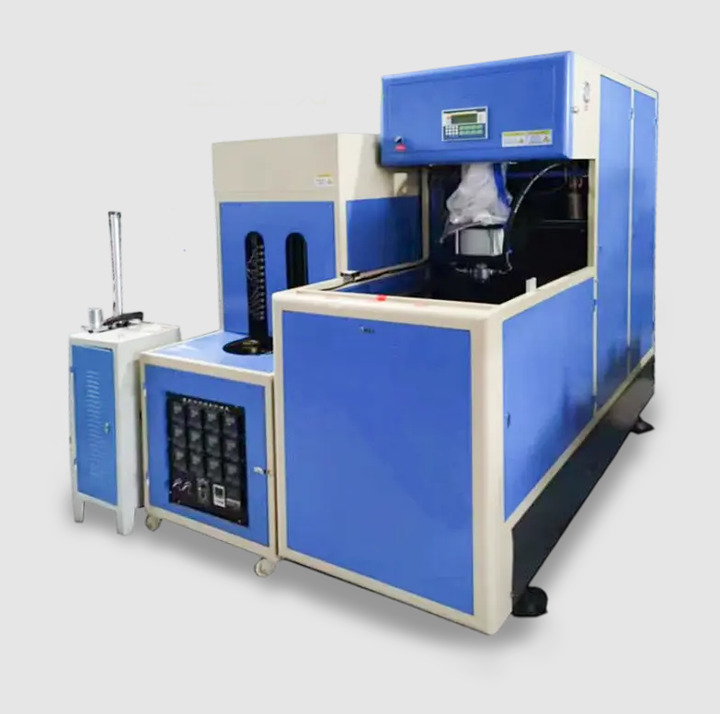
Modern beverage packaging relies heavily on efficient machinery, and two widely utilized types are the Wide-Mouth Bottle Blowing Machine and the Mineral Water Bottle Blowing Machine. Manufacturers seeking to produce containers that meet varying requirements often choose between these two machines depending on the bottle size, intended use, and production volume. Wide-mouth bottles are frequently employed for items such as juices, condiments, or bulk beverages, whereas mineral water bottles typically have a narrower opening optimized for standard drinking use.
The Wide-Mouth Bottle Blowing Machine offers flexibility in handling larger volumes of material. Operators can adjust the machine to produce bottles of different capacities without changing the mold extensively. The process starts with preforms, which are heated to a uniform temperature, making the plastic pliable for the subsequent blow molding. Air is then introduced under controlled pressure, expanding the preform into the mold cavity and forming the final bottle shape. Careful temperature and pressure management ensures consistent wall thickness and structural integrity.
Conversely, the Mineral Water Bottle Blowing Machine often focuses on high-speed production. Its design favors standardized preform sizes to maintain uniformity across thousands of bottles daily. Automation features such as servo-controlled stretching rods and synchronized air injection reduce production errors and maintain consistent dimensions. Some modern models integrate cooling systems that shorten cycle times, allowing continuous operation without compromising the quality of the bottles.
Material choice also plays a role. Both machines commonly use PET (polyethylene terephthalate) due to its clarity, strength, and recyclability. Preform quality significantly affects the final bottle; inconsistencies in the preform can lead to uneven wall thickness or surface defects. Hence, quality inspection prior to molding is critical.
Maintenance and operational considerations differ between the two machines. Wide-Mouth Bottle Blowing Machines require occasional adjustment of molds to accommodate varying bottle sizes, while Mineral Water Bottle Blowing Machines focus on optimizing speed and reducing downtime. Preventive maintenance routines, including lubrication, inspection of heating elements, and monitoring air pressure systems, prolong machine life and reduce production interruptions.
Operators must also consider energy consumption. High-speed mineral water bottle machines may consume more energy per hour due to faster heating cycles, but they achieve higher throughput. Wide-mouth machines, while slower, may allow for more flexibility in production scheduling and batch variation. Understanding these differences enables manufacturers to select machines that align with operational priorities.

Inspire creativity, unleash adventure, and foster connections, all while exploring the world! Geostalgia.com is your American Made Social Network. No Billionaire's are involved with the creation of Geostalgia.
